
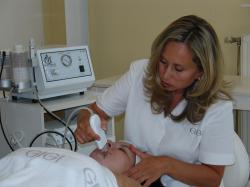
Microdermabrasion (often referred to as Microderm) is a cosmetic procedure popular in day spas, doctors' practices, and medical spas
in which the stratum corneum (dead outermost surface of the skin) is partially or
completely removed by light abrasion. Different methods include mechanical
abrasion from jets of zinc oxide or aluminum oxide crystals, fine organic
particles, or a roughened surface. Particles are removed off through the
wand/handpiece through which the abrasive particles come The term dermabrasion
itself refers to the more severe medical procedure carried out under general or light anesthesia.
Microdermabrasion is used to remove sun-damaged skin and to remove or lessen scars and dark spots on the skin. The procedure is not very painful and requires no anaesthetic. Microdermabrasion can be used medically for scar removal when the scar is raised above the surrounding skin, but is less effective with sunken scars. There is very little, if any, evidence that microdermabrasion stimulates collagen formation. Microdermabrasion can also be used for treatment of acne, but must be repeated periodically to be effective. Microdermabrasion should not be used on patients who have taken the medication Accutane (Isotretinion) in the previous twelve months.

Crystal microdermabrasion systems are the traditional treatment of choice and rely on tiny crystals that are blasted onto the skin to perform the exfoliating process. Although the crystal microdermabrasion system is still widely used, the introduction of alternatives has led to a trend away from this treatment system.

Crystal microdermabrasion systems are the traditional treatment of choice and rely on tiny crystals that are blasted onto the skin to perform the exfoliating process. Although the crystal microdermabrasion system is still widely used, the introduction of alternatives has led to a trend away from this treatment system.


